
Deviant Moon Tarot Deck Review
Creators: Patrick Valenza
Publisher: US Games 2008
Publisher: US Games 2014
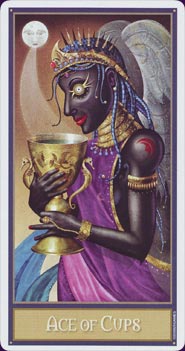
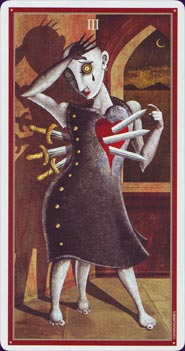
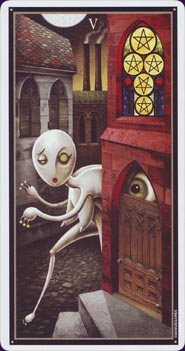
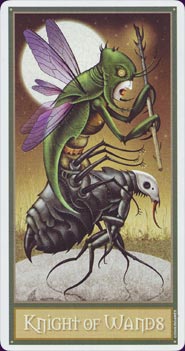
The Deviant Moon Tarot has surreal, very unique, and sometimes disturbing moonlit artwork. It's inspired by (and incorporates) images of cemetaries and mental asylums, and designed to illuminate deeper parts of the subsconscious. The talented illustrator is also a tarot student, and the deck is the result of three years of artistic work. Available now in a borderless edition!
Retailers
See Price at Amazon.comSee Price at Amazon.co.uk
See Price at Amazon.ca
Deviant Moon Tarot Review by Kate Hill
Long awaited by the online tarot community, the Deviant Moon Tarot has also been thirty years in the making by artist and storybook illustrator Patrick Valenza.
Patrick developed his artistic style in adolescence and has been working on his imagery for many years. Not only an accomplished artist, he also has knowledge of tarot and has studied the traditional cards closely. His website shows thirteen hand-painted major arcana cards made when he was fifteen, with very recognisable characteristics – some only slightly altered in appearance (though recreated via photo manipulation) for the published deck. His very unique style has been expanded across the full 78 card deck, with no less attention to detail and variation in the theme.
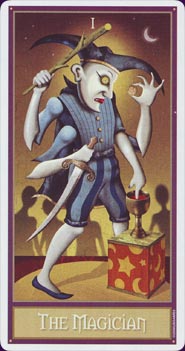
Artistically, the cards are incredibly strong and equally consistent from the Fool all the way through to the King of Pentacles. They are dark on the surface and underneath; photographs from cemeteries and tombstones have been morphed and twisted into other elements of the cards: clothing trim, headgear and shoes. The backgrounds are urban and industrial, scenes are often set outdoors but there is little natural environment; the moon rises over smokestacks, dull and dirty skies, fortified buildings – all created from photographs of a mental asylum. The figures in the cards are non-human, with layered faces and moon-like masks, wide staring eyes, bird-like feet and often elongated bodies. Despite the lack of regular human facial expressions and body language, the figures are remarkably expressive.
It’s a deck of the subconscious, of bad dreams, of visions from a bad trip come to life. Patrick’s symbolism comes from childhood dreams and imagination, a visual dedication to his interest in the ‘more melancholy side of life’. It’s reminiscent of its Rider-Waite heritage but really has a feeling all of its own. It’s a nice change to see imagery with such polish and dedication that also has an obvious familiarity with the tarot’s symbolism; it stays true to tarot but brings to it a new and disturbing approach.
The cards depart from traditional elements of symbolism in many ways but the card’s tarot meaning is still clear. As in the Nine of Cups, the well-dressed character releases a genie from the bottle and looks on with surprise; a very appropriate image for what is traditionally known as the ‘Wish’ card. The King of Wand isn’t seated on a throne, and instead holds woodland creatures by the hand and strides through the scene, but still comes across as the confident, charismatic leader.
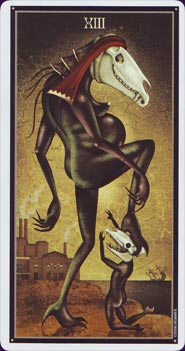
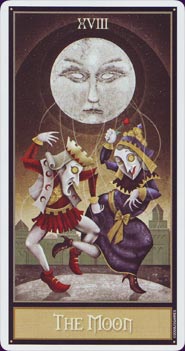
The Moon card is literally the puppet-master of the figures below, holding the strings that connect them and controlling their movements. Ugly but strangely elegant, Death has a red scarf wrapped around her skeletal horse head and a pregnant belly, signalling both the end and the beginning inherent in transformation of Death. The cards do have an uncomfortable edge, even in traditionally positive and usually pretty cards like the Star.
The companion booklet is entirely in English and for each card shares a description of the imagery and a few keywords for the upright and reversed aspect of each card. Reading the booklet really not necessary to use the cards – all of the depth is in the imagery itself, there is little further background or explanation needed. There’s an original ten-card spread as well, based on cards arranged simply in a circle.
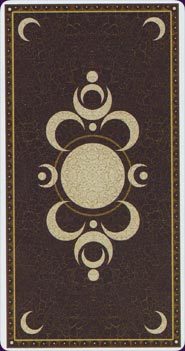
As is common for recent decks from US Games, the card stock of the Deviant Moon is very slick and heavily laminated. The backs are reversible and have a dark brown background with geometrically arranged crescent-moon designs. There are two extra non-tarot cards; a title card with the angel from the Judgement card, and a card ‘About Patrick Valenza’ with his background and artistic history. The cards have their own box that holds them and the booklet, and this sits with a fold-out spread sheet inside an equally glossy outer cardboard box with a slipcase cover.
A little tarot knowledge is always useful, but it’s not mandatory to use the Deviant Moon. The dark and strange beauty of its imagery takes a new approach but is true enough to the tarot archetypes to be useable by readers from novice level to the well experienced – as long as you’re prepared for a little excursion into the dark side of your subconscious.
Deviant Moon Tarot Review by Dan Pelletier
Dan Pelletier Test Drives the Deviant Moon
I received The Deviant Moon Tarot on a Monday and spent four days doing nothing but pursuing the cards.
Back in 1909, Pamela Colman Smith’s artwork set the stage for Tarot in the twentieth century. Her work resonated for ninety-nine years for a good reason. In 2004 Robin Ator, in a brilliant stroke, removed the anachronisms and gender bias leaving color and form from her work with the International Icon Tarot.
Four years later, Patrick Valenza has gone even further; he has dispensed with the humans, the symbology, and everything else recognizable; his work wrests the Tarot from the Egyptians who never had it, the Golden Dawn who bastardized it, and the New Agers who sanitized it.
On his website and in interviews, the artist describes how he created texture maps from photographs of graveyards and an abandoned insane asylum, and then manipulated the images to create the artwork.
The images themselves are absorbing surrealistic humanoid figures in abstract settings, that are at once attractive and haunting. Many of the faces are ‘split’ between a light and dark half, some faces appear to be masked, and on others the masks are faces, some appendages have multiplied beyond the two that we’d see in a humanoid... we expect to see some things, and we see what we expect... and then are left unsettled as the images unfold.
I’m not marginalizing the how the Deviant Moon art was created; but what I care about is how it handles on the road. What I care about is the result of the manipulations of imagery. I want to see how it corners, what kind of mileage would it get? So after four days of pursuing the images, I had an internet-radio spot to do consisting of two hours of reading for strangers I couldn’t see.
And once I began, any expectations I had proved to have fallen short, the images in the deck performed with an uncommon accuracy. The occupants of the Deviant Moon world did the gossip and gavotte adeptly.
But how? Why does it work?
The Deviant Moon is character driven. And as opposed to Asian ‘character driven’ decks that lack any symbolism and use innocent poses, the Deviant Moon takes a rather unique approach.
Patrick Valenza accomplished something quite unexpected, facilitated because he used a surrealistic approach to the Tarot. He has his static humanoids performing the dynamic actions that pertain to the card’s meaning. For most cards, it is a simple matter of ‘what is this character obviously doing now’ (or just completed, or about to do). Because of the organic and narrative approach to the subjects, we are also able to understand how each of the characters feels.
The Tower is a tower, and the Devil is a devil (great feet), Temperance pours from one container to another, there are stars on The Star.
However the images keep unfolding.
There were little details that popped out during the readings, and I had to go to the source for some answers.
“Uh Patrick, I notice there are a few oddly placed clocks with unexpected times displayed, for example in the Eight of Pentacles the clock displays eleven fifty-eight.”
“Thanks for noticing” answered Patrick, with a wry smile, “Yup, two minutes to midnight...all the work you do in a day, and there is always more to do the next. Day in and day out. Hoping for something to show after all of this work...maybe you won't see it today, but maybe tomorrow.”
“How about the Four of Pentacles, the clock there displays nine forty.”
Patrick pauses and leans back. “There’s a background story here. My father-in-law was a greedy, materialistic man. Everything in his life was based on what he owned, and always put himself over his children. Well, the day came when he finally died. We heard the news at about 9:40 one morning. Nobody was particularly heart broken. I always wondered what he thought, lying there waiting to be cremated....does he say to himself, ‘I wish I spent more time with my children as they grew up’, or was it, ‘DAMN, I didn't make enough money!’ So in this card, the death angel leads the miser to the fires of the furnace, with the symbol of time dangling from her mouth. The miser looks back on his possessions in fear that he will never see them again, while clutching a few golden pentacles in a last attempt to "take it with him".
I ask “How about the Hanged Man. His clock says five eleven.”
“I used to work at the most mundane job years ago...a real nine to five. Many times, I would work a bit past the whistle. I found it a total waste of time, but back then I had little choice. I felt I was in limbo, and had to make a real effort to break free of my suspended life. This clock represents my lost time there and the times I worked past 5:00.”
“One last question Patrick, tell me about the borders...”
“The mixed colors come from the cards I created when I was 15. Truthfully, the colors on the majors just looked good with the color compositions of the individual cards at the time, so I just carried that over when I re-began the deck in 2004. However, the minors were different... these colors relate to the citizens of each realm. The borders on the suit of Swords are Red for their strife and pain of the heart. Cups have Blue for the calm purity of the sea. In Wands I used Green for the earth and the natural world. And with Pentacles, Black for the materialistic void they have in their souls.”
So now that we have more information, we’ve also left the antiquated suit meanings in the past where they belong, in the latter half of the Victorian era. Even Majors refuse to pay homage to this era by using the Continental numbering system.
This is a great deck for the reader who does not want to read a book and be told what meaning is.
But I have to provide a strong caveat…if you are a reader who prefers sunny bunny over truth – don’t visit this deck. The Deviant Moon strikes to the heart of issues, with the same ease that it pushes aside six hundred years of Tarot myth-takes; it dives directly towards the truth. That will unsettle many.
It’s often difficult to remember, that the voices that whisper in the darkness from the peeling walls, often speak the truth.
Deviant Moon Tarot Review by Terri Clement
The Deviant Moon Tarot is a Moon theme RWS based deck. The art appears very abstract, medieval and is inspired by ancient Greek art. It is a bit on the darker side, but I would not call this a dark deck. It actually appears to be a very workable deck. It will appeal to many, both Readers and Sitters This deck will be especially attractive to those who are fond of the non-traditional or maybe even looking for something a little creepy.
This deck measures 2 ¾ inches wide by 5 ¼ inches tall, which is a bit taller than standard. There are narrow white borders. Very nice cardstock with smooth finished edges. A workable amount of laminate. Easy to shuffle for those with a little larger hand. The backs are an artistic compilation of moons and is reversible friendly.
Justice is numbered eight and Strength is number eleven. The Death card does not have a title. All of the other Major Arcana have their original titles. The Minors are of standard suit, Swords, Cups, Wands and Pentacles.
The Little White Book included with this deck, gives meanings for the Majors and the Minors, in both upright and reversed positions. Refreshingly enough, there is not Celtic Cross spread shown! The spread in the back of the LWB is the Lunatic Spread, which is a ten card spread. It’s nice to see someone take some creativity with their LWB!
Patrick Valenza created the Deviant Moon Tarot, basing it on childhood images and visions seen through his imagination and brought with him, into adulthood. He was born in Long Island, New York. He has had a love of art, since his childhood. He discovered Tarot at a very early age and has studied it quite intensely.
Patrick finds it easier to tell people stories with pictures instead of words. He enjoys “tiptoeing” through 18th century graveyards and exploring abandoned buildings.
His art ranges from detailed colored pencil and acrylic drawings to photographic manipulation that is used in combination with digital drawings, which was used to create this deck. Each card began with a drawing, that was scanned into a computer, then they were manipulated. The background buildings were created with photographs that he took of a local abandoned insane asylum.
I particularly like what is going on in the background of each card. There are many unique old-style buildings which look like old factories, churches and abandoned buildings. There is a lot going on in each card. All of which can apply easily to your readings.
Deviant Moon Tarot Review by Bonnie Cehovet
I was extremely lucky, and was able to obtain one of eight “Deviant Moon” decks that Patrick (please excuse the informality – this is how it seems best to address this esteemed artist/Tarotist) charged under the recent Super Moon. The consideration Patrick gave to not only charging a deck for his own use, but to graciously offer several charged decks for sale to the Tarot public left me astounded and even more appreciative of this phenomenal person.
The deck arrived as promised – wrapped in black with silver markings, with the cover card and inner flap of the card box signed. Not just signed – pentacles graced both side flaps, with the longer top flap signed with his name and a little signature drawing. Of course I was very careful to slice the tape on the black wrapping very carefully so that nothing was torn! The wrapping is as much a “keeper” as the deck itself!
Because of the charged nature of the deck, it will be set aside for personal readings and ceremonial/ritual work. Patrick – many thanks for offering us this delightful opportunity!
When I first came across the “Deviant Moon” Tarot, I wasn’t sure that it was for me. As it kept crossing my path over time, it just drew me in. Those things happen! Patrick’s blog is of course now on my RSS feed!
The “Deviant Moon” was created with what Patrick refers to as “photographic manipulation” – each card beginning with a complete drawing which was scanned into the computer, then layered with various photographic texture. I was astounded to read that most of the clothing worn by the citizens of the Deviant Moon was nineteenth century tombstones that were bent and twisted digitally to become capes, boots, hats and trim! I might want to mention here that the foundation for this deck came from gently tiptoeing around the graveyards of eastern Long Island, New York, with a bit of influence from mental asylums!
The artwork is abstract (to say the least!), with influences from ancient Greek art. The figures were drawn flat, with an emphasis on heavy light and shadow. As the deck progressed, the characters began to evolve into the form that we see now – moon-faced brings. The incredible twilight energy of the cemetery influence, along with the lunar influence of the moon faces is stunning. What looks like perhaps an art deck at first takes you laces that you never thought you could go – places that you never thought existed. This will certainly be a deck that I use when I need to nudge myself out of the doldrums, and it certainly works well as a comparative deck – i.e. a deck used in a comparative reading, where the cards are drawn from one deck, interpreted, and then the same cards are drawn from a second deck to get another sense of what is there. (Many thanks to Valerie Sim for making this a widely used tool within the Tarot community through her work.)
The symbolism in this deck comes from Patrick’s childhood dreams and from his own fertile imagination. The deck itself is a traditional 78 card deck, with the Major Arcana carrying traditional titles. Justice is VIII, Strength is XI. The suits are Wands, Cups, Swords and Pentacles. The Court cards are Page, Knight, Queen and King.
Patrick defines the suits as follows:
Wands: The tribe of wands lives their life with passion and creativity. When faced with problems, they use their ingenious imagination to overcome adversity.
Cups: The realm of the cups is filled with new promises. They represent hopeful people who build harmonious relationships with their fellow citizens.
Swords: The family of swords is a powerful clan, yet its members are troubled with conflict. In spite of their problems, they persevere through strength and fortitude.
Pentacles: Those who dell in the city of pentacles are hardworking and industrious. However, they sometimes pay the price of placing material gain over spiritual well-being.
The LWB (Little White Book) presents the cards in text format only. The cards are presented with a short description of the card’s energy, along with upright and reversed meanings. From the LWB:
XVIII The Moon
The deviant moon casts its powerful influence over the city, controlling minds like a puppeteer.
Upright meanings: Brainwashing. Dark influences. Trickery. Illusion. Subconscious control.
Reversed meanings: Avoiding reality. Strange forces. Delusional thoughts. Lies and despair.
Nine of Wands
Trapped in an underground maze, the lad searches for a way out. Resting on a ledge, he considers giving in to his seemingly hopeless situation. Eight wands mark the path to a possible exit. A ninth wand ignites his resolve not to give up.
Upright meanings: Stopping to ponder during challenging events. A pause. Summoning the will to continue with a struggle. Hope.
Reversed meanings: Delay. Insurmountable obstacles. Giving up. Lack of motivation or willpower.
Queen of Pentacles:
The gracious queen revels in her luxurious lifestyle. However, she is somewhat detached from the needs of her people. She shows her royal pentacle to an audience of dolls, mistakenly believing that society will benefit from this act of misplaced charity.
Upright meanings: Luxury. Affluence. A gracious hostess. Charity and generosity.
Reversed meanings: Dependent on others for monetary support. Untrustworthy. Poor social graces.
The spread presented at the end of the LWB is the ten card Lunatic Spread. A very nice incluse are several blank pages meant for notes.
The cards themselves are 2 ¾” by 5 ¼”. They are of good quality card stock. The backs have a ¼” white border, with a gold and black inner border. Crescent moons sit in the four corners, with a full moon in the center, surrounded by crescent moons worked into graphics. The background is black, the symbols are gold. The backs are reversible.
The card faces show a ¼” white border, with a gold strip on the bottom of the card on the Major Arcana and the Court cards containing the card title in white. The Major Arcana and Pips show the card number in Roman numerals at the top of the card, in white.
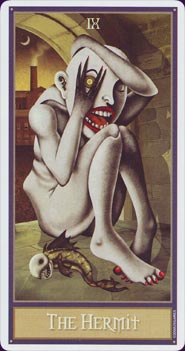
The Hermit, which is one of the cards that I look at first in a new deck because it is one of my Birth Cards, shows a figure hiding in his alcove, seated, with his knees up and his arms over his head. The rotten fish beside him shows that we can never hide from ourselves.
The Empress is quite interesting, as her body faces the right (generally taken to be the future), while he head is twisted to the left (generally taken to be the past). She holds a flower in her hand that emanates from her body (quite interesting!).
The Devil is an adorable figure in red, with gray wings, dancing on a volcanic globe that he has created with his own actions.
The Eight of Cups shows a female figure in a red dress, walking away from the cups, both arms raised with her hands pushing the cups away from her. She is abandoning her old ways.
The Four of Pentacles is quite a unique card, showing a figure holding his four pentacles to his chest, while on his left hand side a demon escorts him into the roaring flames of damnation.
I love the depiction for the Sun, which shows the sun in full light, with yods dropping from it and two figures (twins) dancing in front of it.
The Five of Cups is actually humorous. We see the three overturned cups on the ground, with two upright cups sitting on a wall. Next to the upright cups is a husband, with his fingers in his ears. Behind him is his shrew of a wife, berating him. A rose lies on the ground, in remembrance of the love that once flourished between them.
The Four of Cups shows a maiden who has locked herself on her balcony. Uhappy with lifes gifts, she tosses a golden cup into the sea.
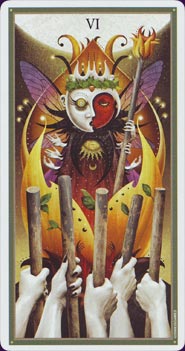
The Six of Wands shows a new being emerging from a moonlit flower bud. Five wands are held high in honor of he event, while the emerging being holds the sixth wand in their hand, bestowing good fortune on everyone.
This is a deck that will appeal to those wishing to push their own limits, to access their unconscious and to face their shadows. As mentioned above, it is also an excellent deck for comparative reading. It will also appeal to Tarot collectors, and to those interested in differing types of art. For me, even though the art is at times disturbing, it is consistent, it is real, and it carries through the traditional theme of each of the cards.
© March 2011, Bonnie Cehovet
Complete Details of Deviant Moon Tarot
Creators: Patrick ValenzaPublisher: US Games 2008
Publisher: US Games 2014
Deck Type: Tarot Deck
Cards: 78
Major Arcana: 22
Minor Arcana: 56
Deck Tradition: Mixed
Minor Arcana Style: RWS-Based Scenes
Suits: Cups, Swords, Wands, Pentacles
Court Cards: King, Queen, Knight, Page
The Fool is 0
Strength is 8
Justice is 11
Card Size: 2.75 x 5.13 in. = 6.99cm x 13.02cm
Card Language: English
Card Back: Reversible
Back Design: Brown leather look with white crescent moons and circles.
Companion Material: 48-page little white booklet in English.
Rating: 18/20 or
 stars out of five
Similar Decks to Deviant Moon Tarot
Theme: Dark & Gothic, HalloweenCategory: Popular Tarot Decks

< Previous Deck · Back to Top · Next Deck >
Home > Tarot Reviews > Deviant Moon Tarot Review
